Once again, God gets blamed |
|
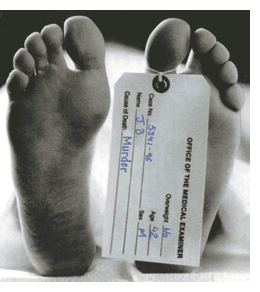
Prof. Schwartz says we still fight wars because of our Western concepts of exclusivity and our sense of belonging. These concepts originally came, she suggests, from the Biblefirst starting with the story of Cain and Abel. If God had never accepted Abel's sacrifice and rejected Cain's, then the latter's envy would not have awakened, stretched, and yawned, until it was awake enough to murder. Cain did the deed, she says, but it was really God's fault. Blaming God for our transgressions goes back another generation, to Eden. "The woman you gave me," Adam accused. But the charge didn't stick. Neither does Schwartz's charge regarding Cain. Listen in on the counseling session God held with the jealous brother: "Why are you angry? Why is your face downcast? If you do what is right, will you not be accepted? But if you do not do what is right, sin is crouching at your door; it desires to have you, but you must master it" (Gen. 4:6-7 NIV). God tried to guide Cain away from isolation and exclusivity. He wanted more than anything to include him in the worshiping community. But God wanted it to be Cain's decision; He wasn't going to force Him. It is true that monotheism (the term encompasses so much that is ungodly) shares much of the guilt for encouraging violence and bloodshed around the worldeven biblical monotheism, as practiced by constantly straying people. It was easy for "We are God's chosen people" to morph into "Love your (Hebrew) neighbor and hate your (unbelieving) enemy." But God had a different thing in mind. Not content to leave the world in an "us/them" dichotomy, He calls His people to conquer the worldnot with the sword, but with a message of love, forgiveness, reconciliation, and community (2 Cor. 5:17-21). |
| Steve Singleton DeeperStudy.com |
Want to go deeper?The Greek verb katallassō ("reconcile, put into friendship again"), along with the corresponding noun katallagé ("reconciliation, being made friends again"), is an important component of the meaning of Christ's death on the cross. The meaning of the terms is clear because Paul uses the verb to describe bringing an estranged couple back together again (1 Cor. 7:11). "Reconcile" means that all of the hurts heal, all of the coldness melts. Smiles return to faces, and hearts that have that have been aching apart become knit together once more. Take that same alienation and estrangement, multiplied many times over, and apply it to the relationships between Jews and Gentiles. Over the centuries mistrust, animosity, and downright hatred built up until a thick and high wall separated the two. Jesus broke down that dividing wall. By making peace, he dissolved the barrier and brought reconciliation between the races, making them one (see Eph. 2:11-22). Christ made it so that the old categories--Jew, Gentiles--lost their meaning in the new reality, "Christians" (Acts 11:26). "Hopeless," "without God," and "far away"--that's how Paul describes Gentile unbelievers in Eph. 2:12-13. Their estrangement from the Jews was only a reflection of their deeper estrangement from God. In describing the progressive downward slide of paganism, Paul says three times, "God gave them over" (Rom. 1:24, 26, 28). Because Gentiles turned their backs on the God they could clearly see revealed in nature, He gave them over to their own perverse desires, including idolatry, depravity, and a range of lusts, culminating in a flood of debauchery, violence, and monstrous self-centeredness. They reached the point where they not only practiced what they knew to be dead-wrong, but they approved of others doing it (see Rom. 1:18-32 for the entire word-mural). But God was unwilling for the world to remain such a mess. He initiated a way to "reconcile the world to Himself in Christ" (2 Cor. 5:19). Paul explains, "He made Him who knew no sin to be a sin offering for us, so that in Him we might become God's righteousness" (2 Cor. 5:21). He's willing to put on Christ the sins of all of us who come to Him in trusting faith, willing to renounce sin, and become united with Christ, with His death, and with His resurrection, and so becoming clothed with Christ (Rom. 6:3-7; Col. 2:12-13; Gal. 3:26-27). Then another fantastic thing happens: God commits the ministry of reconciliation to us, who have experienced reconciliation. He challenges us to plead to the unreconciled to join us in this new community of the redeemed: "We implore you on Christ's behalf: Be reconciled with God" (2 Cor. 5:20). Jeremiah Burroughs. Gospel Reconciliation (2006). While Jeremiah Burroughs (1599-1646) was loved for his preaching and gentle spirit, he was persecuted for his non-conformity to the Church of England. This series of books by Burroughs shows us how to adorn the doctrine of God in all things, as Paul wrote to Titus. We are to adorn the doctrine of God in our worship (Gospel Worship), in our reverence (Gospel Fear), and in our conduct (Gospel Conversation). To adorn the doctrine of God, we must know God and Christ (Gospel Revelation); we must know the blessing of being forgiveness (Gospel Remission); and we must know the marvelous plan of salvation God offers to us (Gospel Reconciliation). Recommended for online reading: John Campbell. "The Subject of the Atonement [or Reconciliation] Examined," 1:365-367 in Gospel Advocate (1823-24). |